For nearly 4 years, the Royals have been working on trying to build a new home. We’ve seen official renderings for 3 different sites, and 1 non-official site, prior to April 22nd, and rumors for 5 other sites. We saw two states, multiple cities, and counties all going at each other over the new ballpark issue. We had a 3/8-cent sales-tax renewal vote, which ultimately failed, in April 2024 setting off a showdown that ultimately culminated into Wednesday’s announcement.
There’s no doubt in my mind that momentum exists.
In the aftermath of the April 2024 vote, as someone who supported “Question 1”, I wondered about where the Royals and, to a lesser extent. The Chiefs would go after the measure failed. I remained confident that the Royals wouldn’t hop the state line to Kansas, but would instead remain focused on a site somewhere near the heart of the region. My personal preference, in the aftermath of the vote, was North Kansas City but that eventually moved on to 18th and Paseo before becoming open to a stadium anywhere in the “greater Downtown KC” area.
At one point, when local media heads were stating that Aspiria in Overland Park would become the new home of the Royals, my position became “if it’s between the team leaving the region or moving to Overland Park, I’ll take the Overland Park option”. Thankfully, such an idea never carried much weight, especially after the games the State of Kansas had to play in order to bring the Chiefs across the State Line (which has had no formal plans or concepts revealed yet in the 5 months since the announcement).
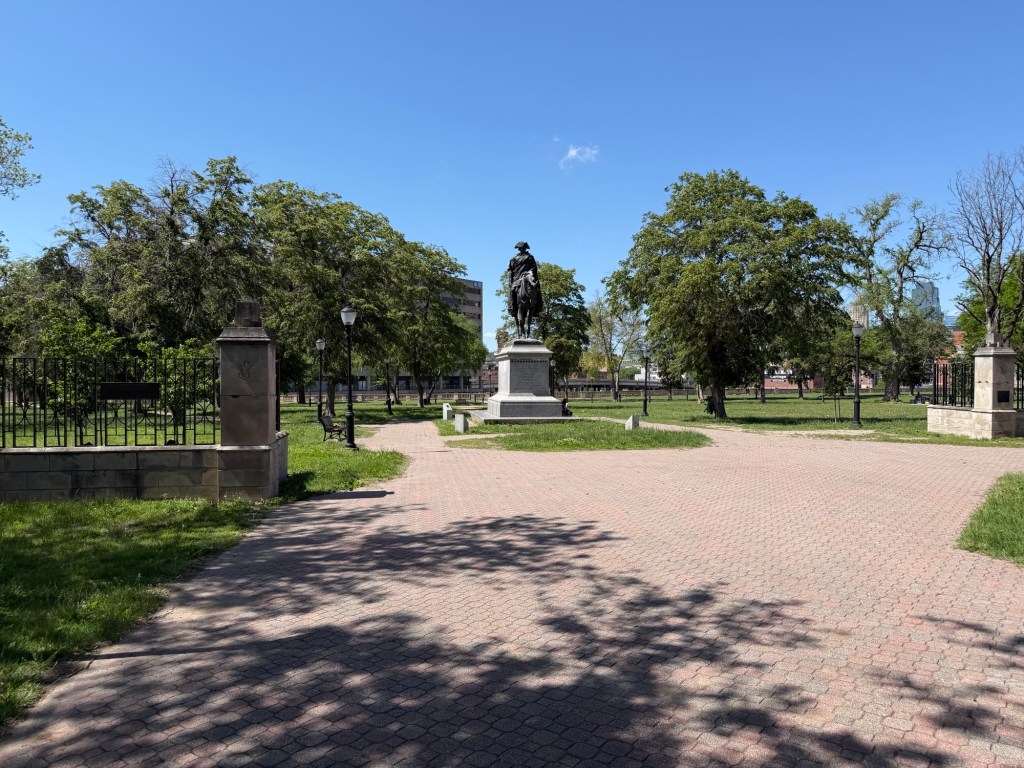
I chose to move to Kansas City from my hometown of St. Louis on the basis that you can feel a sense of momentum here. People are moving here and businesses are surely to follow (if not now, then in the near future). Long overdue investments are being made in the form of strong public-private partnerships, which are bringing new green spaces, pedestrian infrastructure, Streetcar lines, and mixed-use developments to house new neighbors and businesses of all sizes. Even those investments aren’t without controversy, but all of them will eventually make the City a better place to be. I’ll still always be from St. Louis and growing up there shaped me, especially when it comes to attending a sporting event, like a Cardinals game.
The experience of my grandparents taking my siblings and I to baseball games at Busch is something I’ll always remember. When I got older, and went to games with my friends, I remember taking the MetroLink from Shrewsbury all the way to the Stadium stop in Downtown. Celebrating the hits, stolen bases, home runs, double-plays with thousands of other Cardinals fans with the backdrop being the Gateway Arch is something that can’t be taken away from my memory. And it’s a memory shared by hundreds of thousands of people.
After moving to Kansas City, and seeing what the Royals wanted to do, I instantly knew that it would benefit the present, and future, Royals fanbase to finally “move up” in the world and experience Downtown Baseball. You can’t knock it until you experience it for yourself. And just like how I never experienced a baseball tailgate at a stadium out at the intersection of two interstate highways before moving here, I have grown more comfortable with the experience but still feel like it lacks the energy necessary to bring people down for a game even when the team’s performing somewhat poorly.
That feeling, along with the momentum Kansas City has, made me intrigued about Royals vision for a downtown ballpark. How could this momentum merge seamlessly with the future of the Royals? Well, we got visions by the team and each version got better with time.
The (Future) New Home of the Royals
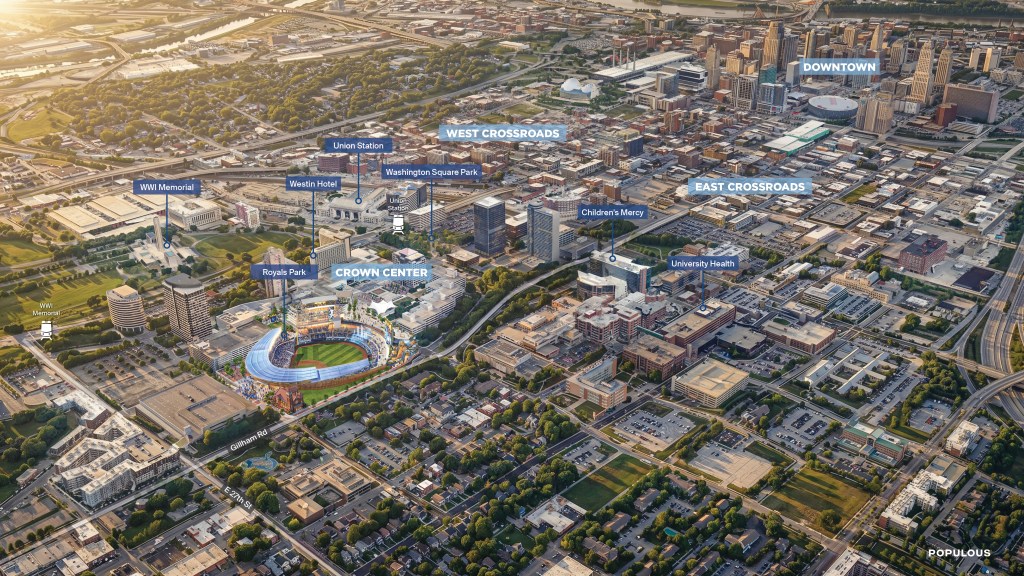
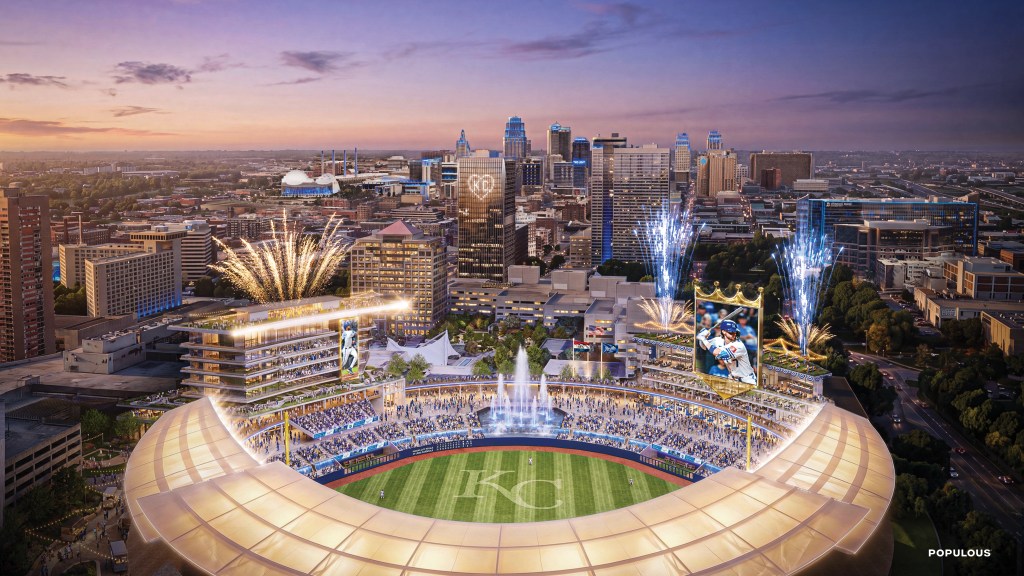
On April 22nd, the Royals officially announced that they would relocate to a new stadium at 26th and Gillham in the Crown Center neighborhood. The plan, which will be done in cooperation with Hallmark Cards and the City of Kansas City, sets itself up well to finally bring the “Downtown Baseball” experience to Kansas City.
Phase 1 is a $3 Billion plan that involves a $1.9 Billion ballpark and $1.1 Billion in mixed-use development that’ll include a mixture of office, hospitality, residential, and commercial space. All of which would build on what’s been established at Crown Center and continue the momentum the urban core of the City has been seeing. Per the team, this is the largest private project in Kansas City history with $2 Billion coming from private funds and $1 Billion from public. And per Governor Mike Kehoe, this is the largest project of its kind in the nation.
The stadium would replace Hallmark’s aging headquarters building behind and to the north of the Our Lady of Sorrows Catholic Church, but Hallmark will not be leaving Kansas City. Instead, they’ll be occupying a new facility better suited to their needs within Crown Center, becoming neighbors to the very team who once tapped them to design their team logo.
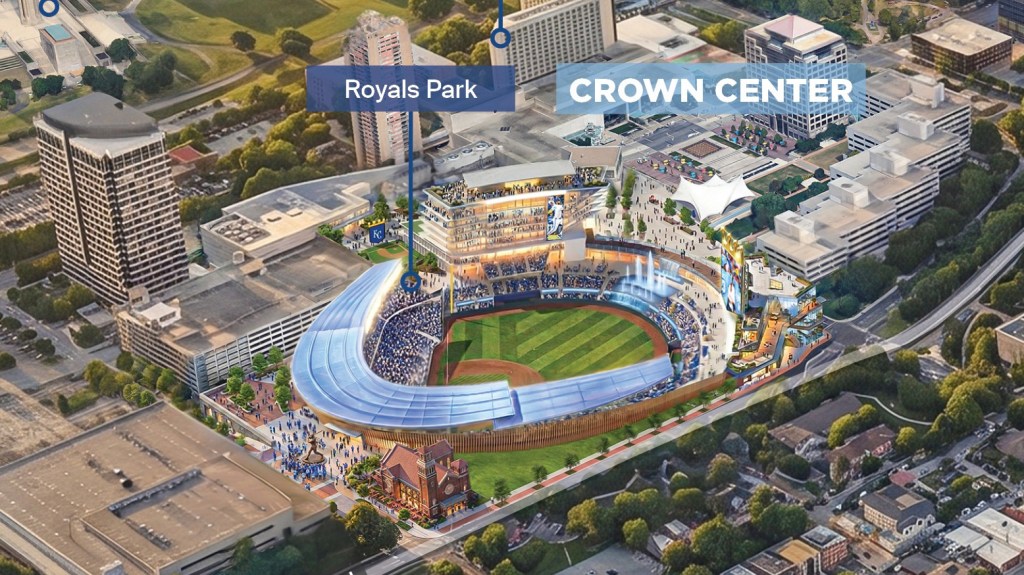
Per Hallmark Chairman Donald Hall, the stadium itself will utilize the site’s 90ft elevation change to “sink” the stadium into the ground to where the elevation along Gillham will only be about 30ft tall (shorter than Our Lady of Sorrows). Per Mr. Hall, this will make the stadium feel “pedestrian scaled rather than an imposing structure like other baseball stadiums in other cities”. Playing on the elevation change as well, Royals owner John Sherman added that “fans entering the home plate gate will actually enter on the upper deck, providing sweeping views of the field and city”.
Details on the specifics of the entire Royals Crown Center plan have yet to be revealed, but will likely become clearer over the next several months. We don’t yet know the capacity of the stadium (the design is still conceptual per team owner John Sherman), and specifics about the total amount of new office, residential, and commercial space constructed in phase 1 aren’t yet known.
We do know that existing Crown Center spaces will be refreshed, the ballpark will break ground in 2027, that Crown Center itself already has 9000 parking spaces within its boundaries with thousands more nearby, and that the Streetcar line will assist in moving fans from the north and south.
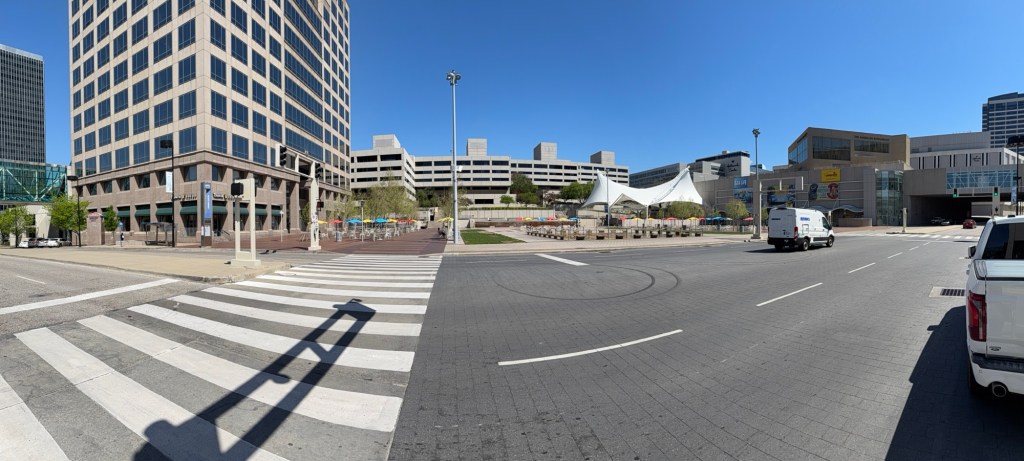
But there’s something historic in this team move, and it’s not just leaving Kauffman for a more central location. It’s that this stadium will be the first modern stadium to actually link a downtown area to surrounding predominantly residential neighborhoods. No other ballpark in the country will give game attendees the ability to experience nearby neighborhoods or hop downtown, all within roughly the same walking distance.
Martini Corner, and the few businesses that occupy spaces just east of the stadium in the Longfellow neighborhood, will help create Kansas City’s own version of Wrigleyville, just smaller. Meanwhile, Downtown’s energy will receive quite the boost from this investment.
What we’ll see with this ballpark, and the revitalization of Crown Center, is a bleed-over effect of investment. Even if the Royals perform poorly, and say their average attendance per game is 10,000, that’s 810,000 new visitors to this area of the City over the course of the regular baseball season. That’s before other events, like concerts, exhibition games, and even potential Post Season games. Of that 810,000 extra people, we can assume roughly a quarter of them (202,500) will patronize some nearby restaurant/bar before or after a game. For area business owners who’ll bring in those people, that’s a solid infusion of cash relative to what’s currently brought in. That cash can be a lifeline for some businesses.
As for the argument that stadium developments don’t generate nearby development, it’s mixed. Examples of successful new stadium-adjacent development can be found in San Diego, Chicago (Cubs), Boston, and Cincinnati. St. Louis’s Ballpark Village, Atlanta’s Battery District, and Arlington’s “Texas Live!” are honorable mentions, but are the result of direct team investment.
In Kansas City, you’re not creating a new district. You’re instead going to see a reimagining of the existing with an expansion in the form of additional housing, hotel, and office space. Those usages alone should create enough density to have Crown Center be somewhat self-sustaining. In the nearby neighborhoods, it’s possible that they’ll see an uptick in developments, but nothing that overpowers the existing neighborhood. What such investments will look like I can’t yet imagine, but I guess they’ll be more residential heavy. What I do know, and can say with confidence, is that Kansas City’s stadium-adjacent development will actually occur and attract new residents and businesses to the City.
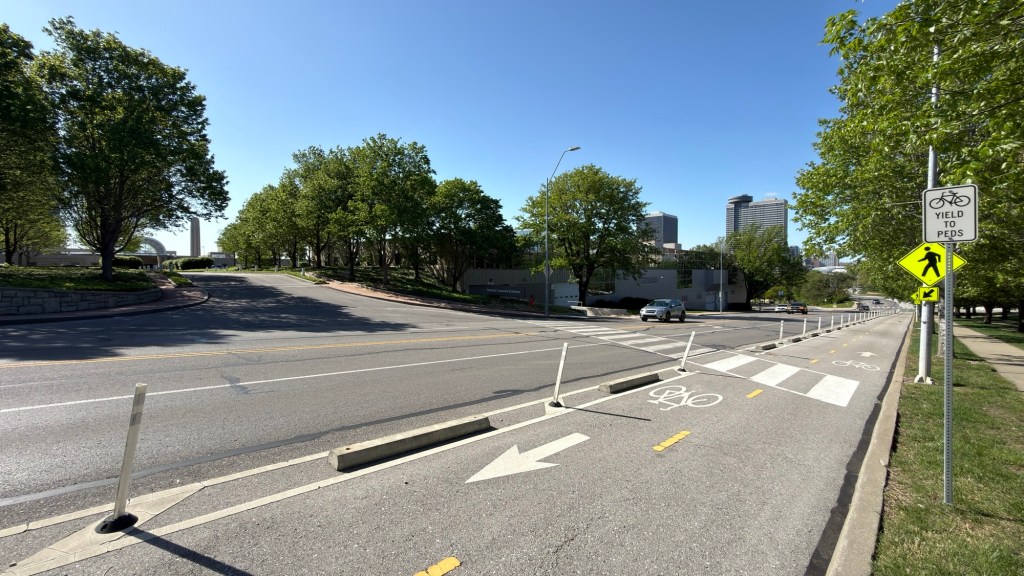
So, over the next few months, more details will be released about the stadium and surrounding development. The $3 Billion price tag for phase 1 of this endeavor makes this one of the largest developments of its kind in the United States right now. It’ll build on Kansas City’s momentum, redefine neighborhoods, and finally bring an experience that Kansas Citians have been missing out on for years now. An experience people will come to enjoy.
It’s time for urban baseball, KC, and we’re finally going to get it.
See you on Opening Day 2031.


Leave a Reply