In the aftermath of the Chiefs announcing a planned 2031 move to Kansas City Kansas, I’m reminded by the opportunity of the Royals potentially remaining in Missouri and, in particular, Kansas City Missouri. The team’s been basically silent on the prospect of a new stadium ever since the April 2024 Jackson County 3/8-cent sales tax renewal vote. Whispers of the Royals choosing Aspiria (119th and Nall) as a stadium site came, drove huge amounts of opposition from Leawood residents, got T-Mobile to threaten to leave Aspiria, and even got the Overland Park Mayor to admit that the Royals should go to Downtown KC. The previously proposed East Crossroads site is now home to a data center. The former BlueCross building at 2301 Main was purchased by a group from Wichita. So where should the team go?
They’ve already stated that will not be playing at Kauffman come 2031, so a new home is still very much in the works. A stadium at the Legends would go against what Royals owner John Sherman stated about wanting to be Downtown in public appearances prior to the April 2024 vote. So that leaves the team, once again, considering the East Village or North Kansas City. Last June, news got out that Gates BBQ owner Ollie Gates pitched a site at 18th and Paseo (KCATA maintenance facility), and I’ve been on board with it since.
I’ll admit that I prefer the Royals being in Downtown, after all, I did grow up attending Cardinals games at Busch Stadium (both 2 and 3) in Downtown St. Louis. There’s something special about going to a game in a Downtown setting. But I’ve also been able to experience game days in Wrigleyville (Chicago) or outside of Fenway Park (Boston). The “neighborhood ballpark” experience is one that’s lacking in the MLB and should make a return, so why not start in Kansas City?
Connections to the Past

Once upon a time, the Kansas City A’s (who moved to Oakland and then decided to move to Vegas, a decision that greatly upset Oakland residents and will come back to bite the team in the future) and the Chiefs, played at Municipal Stadium. That stadium was located at 22nd and Brooklyn, roughly 1 mile away from 18th and Paseo. That site’s now home to suburban style housing, but the legacy and memories live on by those who once attended a game there and the memorial plaza at the intersection.
Arthur Bryant’s BBQ, being just 4 blocks north of the Municipal Stadium site, benefited greatly from the stadium thanks to game day attendees heading down to Arthur Bryant’s for meals.
From 1923 until 1955, the Negro League “Kansas City Monarchs” played at Municipal Stadium. During their time at Municipal, the Monarchs won 2 world championships and earned 11 league titles. Satchel Paige played here and so did Jackie Robinson (who went on to become the first Negro Leagues player to make the jump to the MLB when he joined the Los Angeles Dodgers in 1946. Today, that history lives on in the Negro Leagues Baseball Museum, which is set to move into an expanded museum, with connected hotel, at the southwest corner of 18th and Paseo.
Embracing the Neighborhood
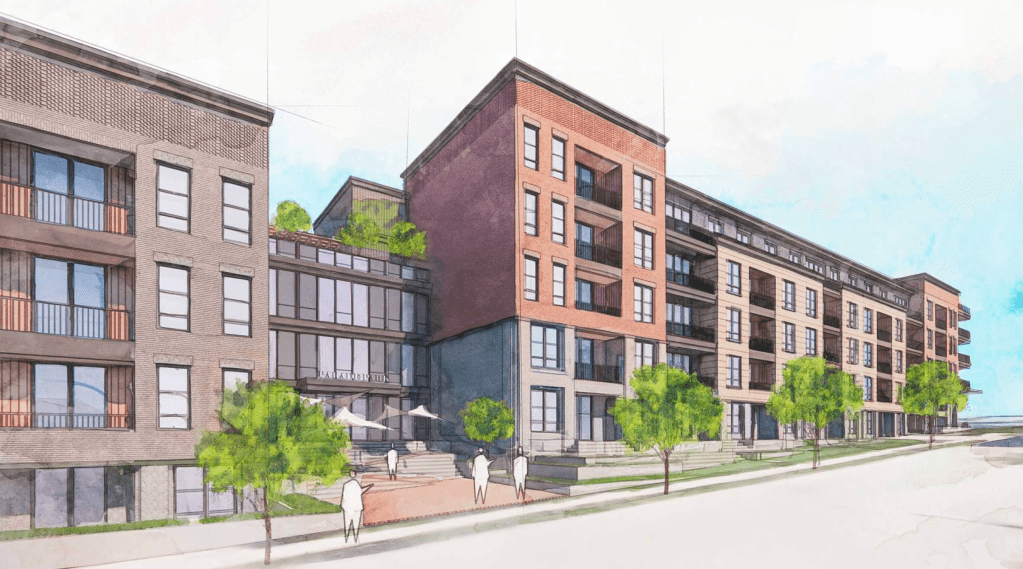
A ballpark at 18th and Paseo would be required to embrace a neighborhood that’s slowly evolving. Unlike Downtown, which is already pretty well-off, 18th and Vine is still finding its groove. It’s Kansas City’s jazz neighborhood with sports integrated into its DNA, but decades of disinvestment have left their scars on the neighborhood. Today, we’ve seen the news that Parade Park is to be redeveloped, the Boone Theater being renovated, the new Negro Leagues museum and hotel, streetscape enhancements on 18th Street, OneNineVine Phase 1 having been completed (with 2 more phases planned), Vine Street Brewing thriving, and more new apartments and retail space set to rise around the old “House of Hits” building just east of the Paseo on 18th Street.
These changes are all anchors themselves and are anchors that a potential Royals stadium would need to work with. The Royals want a mixed-use development of their own, and they can do it on land near 18th and Paseo, especially to the west and southwest. A stadium that’s home to at least 81 home game events per year brings thousands of people to the neighborhood, which should lift up nearby businesses. A mixed-use development by the Royals would bring more people to the neighborhood on non-game days (especially if such development is residential heavy).
The scale and design of a ballpark could be rooted in the brick architecture found in the neighborhood with the ballpark district itself incorporating such a facade material into the mix.
Connecting Neighborhoods
A sign of a thriving City is continuity between neighborhoods. Right now, greater Downtown Kansas City is disjointed with multiple dead zones in between more vibrant areas. The walk on 18th Street through the Crossroads east of Locust to the Paseo is vey obviously a dead zone. Add in a new stadium and it’s mixed-use development, something that would likely be built over 15-20 years, and you end up reducing that 10 block dead zone down to 4 or 5. Not to mention that there could be additional developments that sprout up that end up cutting that dead zone even further.
Additionally, the Kansas City Streetcar’s 18th and Vine extension study would be boosted by such an area anchor and likely justify the investment. I’d argue that such an extension would require upgrades to the rest of the Streetcar line, including extending existing platforms, buying longer trains to handle larger crowds, and build a second maintenance facility to handle an expanded fleet.
“But It’s Too Dangerous”
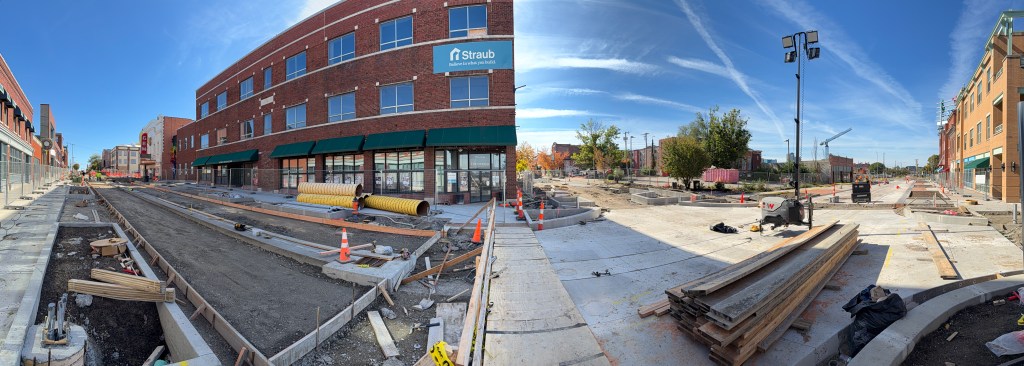
Having large swaths of vacant land, empty buildings, or underutilized land can breed crime as it can hide in the shadows. But in my opinion, the investments into the 18th and Vine neighborhood are chipping away at those shadowy places and a stadium + ballpark district would eliminate a good amount of underutilized land improving the sense of safety on day one. Having more “eyes on the street” also increases safety. A combination of human eyes and CCTV cameras can deter crime.
But if the argument is the area’s too dangerous to be home to a new ballpark, then it’s too dangerous for any of the investments occurring over there. Same goes for the businesses over there. If its so bad, why don’t they just close and/or move? Cities evolve. We have examples right here in Kansas City that demonstrate this.
- Armour Boulevard in Midtown was once viewed as a giant, crime ridden slum. Now it’s home to thousands of apartments for people at various price points and anchors Hyde Park, which itself has been brought back to life in such a way that demand far exceeds supply.
- The Westside was once a rundown part of the City that came roaring back to life, but not necessarily in the way it should’ve.
- Downtown in the early 2000s was a wasteland compared to what it is now. More vacant buildings, seedy characters, and few residents, it just wasn’t a place you’d want to be past 5pm. Investments like the Kauffman Center, T-Mobile Center, and the Power and Light District got the ball rolling on a renaissance that continues to this day. The number of vacant/abandoned buildings has dwindled. But there’s still room to improve.
“What About Parking and Traffic”
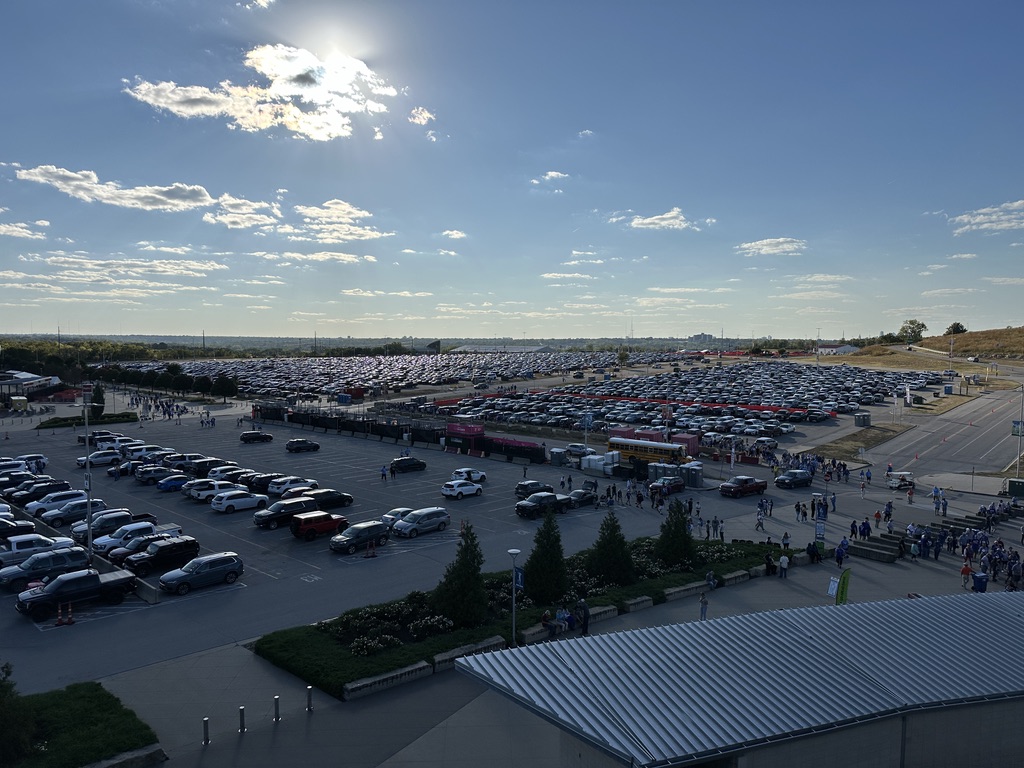
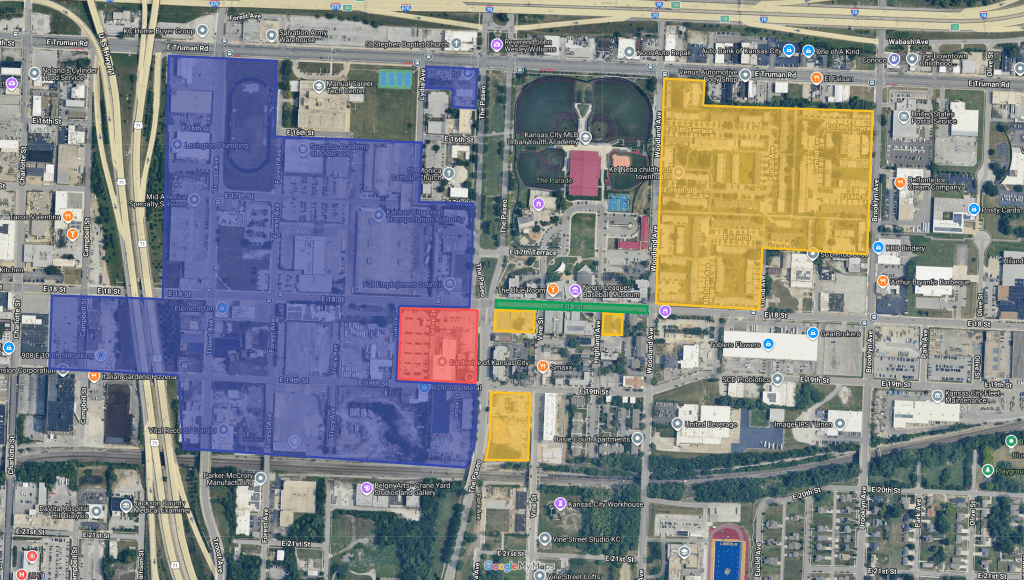
Under a development plan for an 18th and Paseo Ballpark and District, there would be room for parking structures. I believe there are sites located along Troost, Truman, 19th and Campbell that could hold some parking garages for public use on game days, not to mention the new City-owned garage at 18th and Lydia. However, parking shouldn’t consume the district plans. Under no circumstance should there be a sea of parking surrounding the stadium like what’s currently the case at the Truman Sports Complex. Such a design is more inefficient at moving large amounts of traffic due to the limited number of entry and exit points. Spreading garages across a defined area means there’s multiple ways to disperse traffic.
For example, a garage with an exit onto 19th could see traffic directed east to the Paseo to then access US-71. A garage with an exit on Truman could funnel cars east and west. A garage exit on Troost would funnel cars south. A garage with an exit on Campbell could funnel cars west. In between these main roads, you have other streets to help disperse traffic. For those who live in Greater Downtown, it’s possible that they’d walk to games or take the Streetcar (if an extension was built to 18th and Vine), meaning that commuting guests wouldn’t need to compete with neighborhood guests on finding a parking spot. Even if you don’t park in those garages, Downtown has 10s of thousands of additional parking spaces on the street, in lots, and in garages.
In a revitalized neighborhood, the concept of walking to your destination shouldn’t be seen as a hassle, especially since it’s often going to be a longer walk to a stadium entry gate in the sea of parking at the Sports Complex than it will be in the Downtown area.
Wrap Up
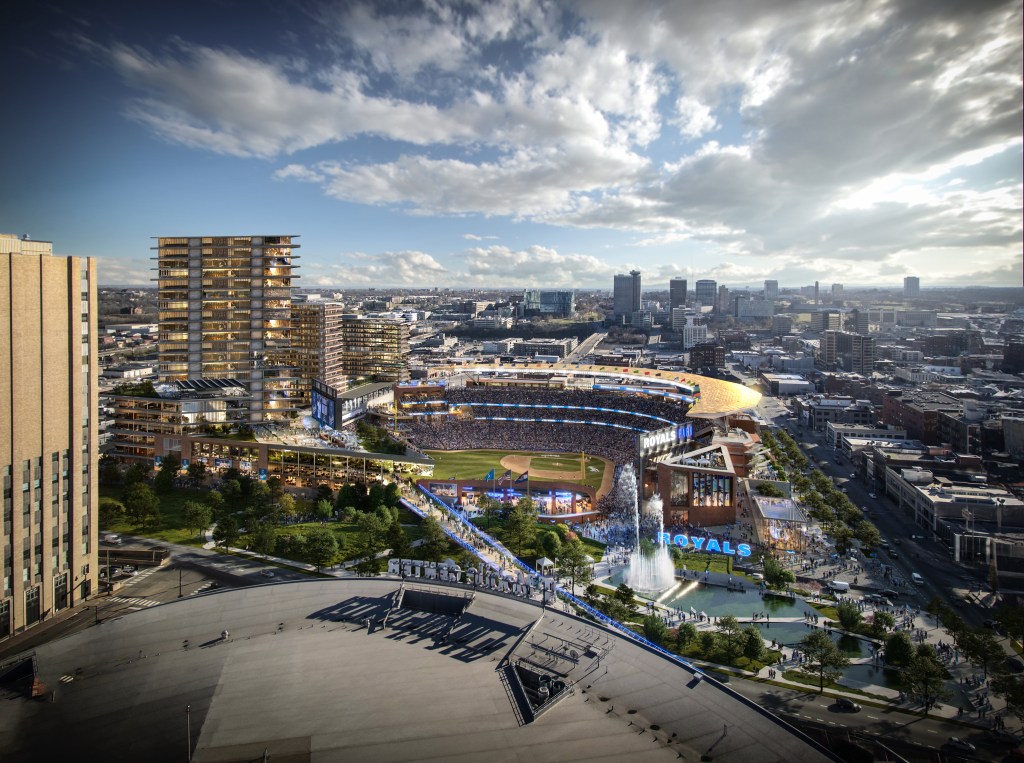
The point I’m making here is that we already know that a new Royals ballpark is going to be a multi-generational investment. It has the ability to change neighborhoods, change the “feel” of the Royals brand, and appeal to a broad range of people picking up fans not yet born. A stadium and district at 18th and Paseo also sends a message that would be heard across the nation that if you think outside the box, you can merge baseball’s past with its future by reinvesting back into the neighborhoods where it got its start.
Of course, we don’t yet know where the Royals will end up. I’ve heard, and seen, things explaining that North Kansas City is “buttoned up”, but on the other side of things I hear that there’s still significant differences to overcome. The East Village could be back in the picture, bringing the new stadium process full circle. Washington Square Park/BlueCross site remains in the minds of many as a potential ballpark site, but how does the new owner play into that vision?
My opinion is 18th and Paseo is the best spot for a stadium and accompanying district that’ll set the tone for further redevelopment and neighborhood connectivity for decades to come while creating a model, modern-day “neighborhood ballpark”. Expanding the Downtown Renaissance outwards will slowly create a more vibrant urban core, something that’ll benefit the City in the long-term.


 The KC Pulse
Leave a comment